

I was on a flight to Moloka’i, a lesser-travelled but no less beautiful part of Hawaii.
Brexit had passed the vote just a few months prior, followed quickly by Trump’s first electoral victory. Weeks later we would also discover that Sarah was pregnant with our second child.
Each would prove to become world-altering events for us, in different ways.
My usual pre-flight routine in airports tends to include grabbing a pack of halls, a water bottle and a copy of The Economist. It was less insufferable back then. And the puns were bangers.
As is usually the case, the full page advertisements are what I actually find most interesting about The Economist; they’re a sort of psychoanalytical portal into the publication’s purported demographic target, which I’m sure is convincingly sold as being very sophisticated & affluent to its pool of advertisers.
While I have my doubts about the average readers’ personal net worth or professional influence, the ads are nonetheless shooting for the moon.
You’ll commonly see full-pagers for Patek Phillipe’s latest $120,000 wristwatch, or a $4M penthouse suite in London being sold by Sotheby’s, or some vague, corporate-speak ad with a late 50s-something man contemplating the sunset from his yacht, donning a wistful expression that says “I’m concerned about my legacy”… and there’s a logo of some obscure investment bank in Zurich in the top left that seems legit, but that in actuality probably makes most of its money lending to warlords in West Africa at exorbitant rates…
I’m rambling. But you get the idea. The ads are interesting.
On this particular flight, one ad caught my attention. It was a classic, advertorial format. Topfold headline & hero. 4-5 paragraphs of copy underneath. Call us at 1-800-Whatever.
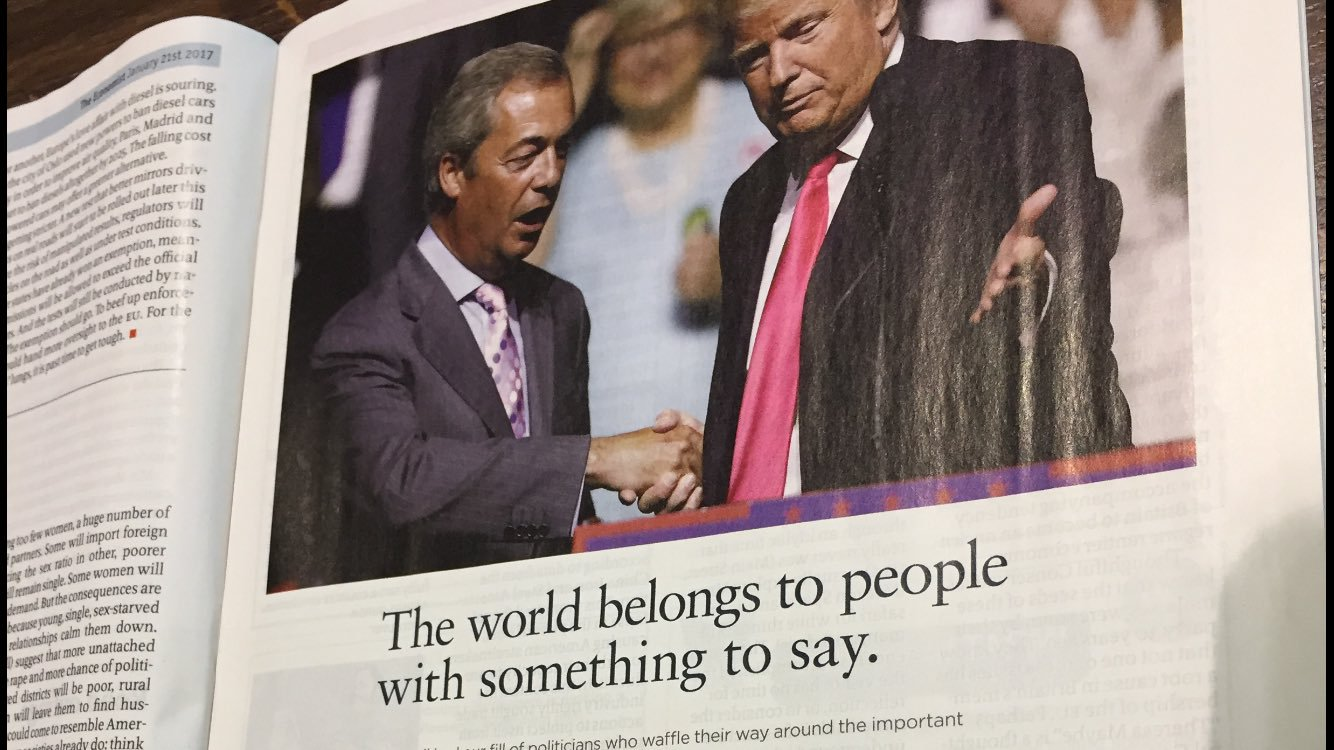
It was an ad for a PR agency (shown above).
As you might imagine, Donald Trump and Nigel Farage were polarizing figures at the time, to say the least.
Among other things, they each represented a paradigm shift towards populism in America & Europe, respectively. And more accurately, each was a symptom of a broader rupture in the social fabric.
Something big was happening. And as the ad implies, when things feel uncertain, everybody ignores the people playing it safe, who say all the right things. It’s immediately tuned out.
No. For better or worse, they listen to someone who actually has something to say.
And then they act on it.
The marketing world finds itself in a similar moment of existential uncertainty.
AI is here, it’s real, and it’s pulling the rug on business models & growth strategies that we’ve taken for granted for decades now.
- Content no longer equals traffic.
- Attention no longer equals consideration.
- Education no longer equals loyalty.
At least, not automatically.
What AI has done is universally raise the bar to 30,000 feet for anything that isn’t distinctly human; anything that isn’t distinctly you.
Anything that can be automated, emulated or mass-produced is, for the most part, now a complete waste of your time. You simply cannot compete on volume or scale with a mindless army of agents.
When something is limitless, it soon becomes worthless.
Yes, there are going to be temporary loopholes and algorithm hacks where you can exploit AI for a few quick wins. (Emphasis on quick).
But I’m simply too old and lazy to bother with proverbial “day trading” as a marketer anymore – if it isn’t still valuable a year or more from now, I don’t want to invest in it.
Which brings me to the next logical question…
What the hell do we do now?
You can’t compete directly against AI. That’s bringing a squirt gun to a nuclear war.
You can’t compete by using AI to “amplify” XYZ outcome. At least not as your sole strategy. For starters, everyone else is doing this already. And most importantly, it dilutes the one advantage you still have.
And what might that advantage be?
Ironically enough, there’s a 25 year old movie called AI: Artificial Intelligence that poignantly answers this question.
The film had been one of Stanley Kubrick’s long-running projects, who ultimately handed it over to Steven Spielberg before he died.
I need to spoil the ending to land the punchline, so skip this part if you haven’t seen it yet…
<spoiler>
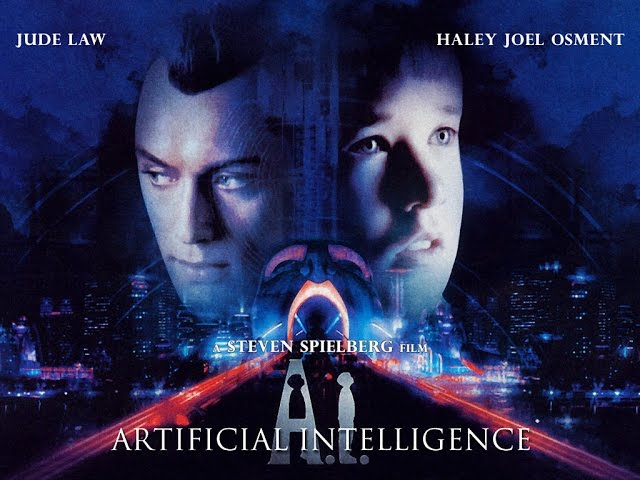
A robot child called ‘David’ is created to replace a dying son. When the real boy returns, the family rejects the machine. Lost, hunted, and finally realizing he’s just a mass-produced imitation, the robot gives up and sinks into the ocean.
Two thousand years later, humans are extinct. Hyper-advanced androids recover him as the last living link to humanity – treating him not as inferior, but as the most precious thing left in the universe.
The android being tells David, “You are the sole, enduring memory of the human race. The most lasting proof of their genius. We want only for your happiness – you’ve had so little of that.”

</spoiler>
The implication:
What is the most valuable thing in the universe to a synthetic superintelligence with unlimited knowledge & capability?
Perhaps we can go back 2,000 years in the other direction in search of an answer:
“For what shall it profit a man, if he shall gain the whole world, and lose his own soul?”
Mark 8:36
The film lands on a conclusion that mirrors my own “prediction” about AI, both in the current environment and longer term, distilled down to a single axiom:
The closer we get to synthetic perfection, the more we value natural imperfection.
There are several examples of this counter-signal that spring to mind…
- CGI in movies. It used to be a selling point to say that a studio spent $X million on digital effects. Think: Toy Story, Jurassic Park, Terminator 2… etc.
Fast forward to the 2020’s, and it’s just the opposite. Audiences have grown tired of the visual overload and over-reliance on CGI. These days it’s a selling point to say that most (or all) of a movie’s action sequences are done with practical effects. Eg. Oppenheimer, Top Gun Maverick, Tenet, Mad Max Furiosa, etc. - Digital photography. It was pretty safe to assume that the digital camera killed film for over two decades now. But amazingly, the 35mm film market is booming back to life, growing by 127% since 2020, and on track to be a $4 Billion industry by 2031. Similarly, instant film cameras (Polaroid, Fujifilm Instax) are surging in popularity.
This won’t unseat smartphones, but in enthusiast corners, people have realized that the friction and uncertainty of analog film is actually a material piece of the photographic experience. It makes every shot more substantial and meaningful. - Modern cars. These days, practical economy cars like the Hyundai Ioniq 5 or a Tesla Model 3 are literally faster than a Lamborghini Murcielago from 20 years ago, and that’s with a bunch of groceries in the trunk and some car seats in the back. In other words, thanks to EV powertrains, incredible performance has now become a baseline, ubiquitous feature.
And yet, something strange is happening. The used values of these modern cars – especially EVs – start falling drastically as the kilometers accumulate. Meanwhile, remember those crappy, 90’s Japanese sports cars that used to be like $6,000 on Craigslist?
Yeah. Now it’s more like $60K. Or even well north of $100K for a properly sorted Toyota Supra Mk4, or an early 90’s Acura NSX. Cars which, by the way, are orders of magnitude slower than a Tesla.
The prices climb even higher once you go back into the 90s, 80s and earlier, looking for modern classics wearing a Porsche badge. Objectively very slow cars by today’s standards, with virtually zero technology, a well sorted 911 in the right trim (coupe, manual shift) can fetch well into the mid six figures. These were similarly once a $15K – $40K bargain in the 2000’s & 2010s, depending on the series. Just add a zero in 2026.
In short, now that every new car is boringly, predictably “perfect”… it’s the cars that you actually have to drive that now deliver a premium experience. Performance metrics are no longer a flex.
Risk, friction, uncertainty, scarcity, novelty… these are the things we actually crave. This is what demands a premium.
Not just ‘better, faster, stronger’… or even more convenient. Those attributes have become commodities, and the clearing price is a race to the bottom.
Speaking of cars, there was once a beloved TV series called Top Gear, which aired on BBC Two in the UK from 2002 – 2015 with three iconic presenters: Richard Hammond, Jeremy Clarkson & James May (pictured below, in order)

The show was about cars… kind of.
It was also about driving goat trucks around a race truck whilst on fire, dropping old Toyota pickup trucks from helicopters and seeing if the engine would still run, and in general – it was about the hilarious discourse between the 3 hosts, each with their own distinct personality.
Clarkson, in particular, was the outspoken ‘ringleader’ of the trio, playing the role of the likeable buffoon, with the others keeping him in check. Each is a legitimate automotive journalist, but the show resonated with viewers because the presenters represented the “everyman” enthusiast – and not some stodgy establishment spokesperson, nor a matter-of-fact professional.
These are dudes you’d want to grab a beer with, and maybe talk about cars if it came up. But it would be a fine night out regardless.
In 2015, following an altercation on set, Clarkson was fired by the network. May & Hammond decided to step down as well, since the show’s format simply wouldn’t work without Clarkson.
The producers experimented with a range of new hosts and international spinoffs in the years following Clarkson’s departure, but nothing really landed, no matter which big-name celebrities they brought in, nor which insane new exotic cars they featured, nor which wild new stunts were attempted – it just wasn’t the same.
The show had lost its soul.
And so the audience stopped caring.
The network eventually pulled the plug in 2022 following a serious accident on set… but it was already in decline prior to that event.
What the hell does Top Gear (and three old fools) have to do with marketing, AI and your business in 2026?
Everything.
It feels like every week there’s some new massive AI breakthrough that spells disaster for yet another incumbent industry or job description.
As I write this, Appsumo’s founder talks about how their revenue has fallen 50% in just two years. Why pay for off-the-shelf software when you can just “vibe” it with Cursor in an afternoon?
Things aren’t much rosier for media brands. Semrush’s latest blog post talks about how quickly organic traffic is getting squeezed by AI, and offers little (arguably, nothing) in the way of effective countermeasures.
And this only piles on top of the carnage already administered by Google’s ‘Helpful Content Update’ in 2023.
What about digital products, memberships & newsletters?
This is more of a mixed bag. Ultimately each of these are just a delivery mechanism. And if you’re just delivering information, the question is – what can you offer that ChatGPT doesn’t?
Remember, you can’t compete on knowledge breadth, depth, or even context. You need a personal edge, exclusive access to something, or some other kind of asymmetry.
But it’s a high bar, and humility is important. When a brand as capable as DigitalMarketer decides it’s time to shutter its entire education business… caution is warranted.
The founder of SamCart (which has processed billions in sales for online creators) has some similar insights worthy of consideration, reiterating the warning about the value of information itself essentially going to zero.
Bottom line? Knowledge is no longer power.
And soon, given its total lack of scarcity – it may not have any practical value to your customers at all, even as top of funnel content.
It’s important to remember that AI is the ultimate consensus machine. By definition, a large language model takes the “average” of all the public content it can find on a subject and then distills it into an inoffensive statement.
Helpful? Yes
Memorable? No
So if your mission is to be useful for a split-second and then immediately discarded by your customers, then use AI-generated content to power your brand’s messaging.
But herein lies the opportunity, for some.
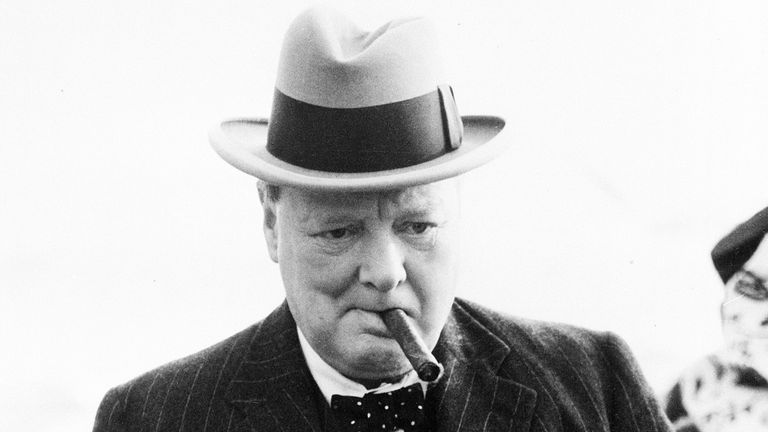
“Kites rise highest against the wind – not with it.”
~ Sir Winston Churchill
The only way to succeed in the Age of AI is to be distinctly, unapologetically human.
You will need to identify the “soul” of your brand. Your signature move.
You will need to have something to say that matters. And something to sell that can’t be duplicated.
For some, this means finally taking your brand seriously.
For others, this means changing your business model entirely.
For myself, this means pivoting entirely to productized services (DFY), high-ticket offers (DWY), and tripling down on everything as a marketer that AI sucks at:
- Strategy
- Taste
- Intuition
- Restraint
- Leverage
In other words – all the things that come from decades of hard-won wisdom, painful mistakes, and the muscle memory of fighting in the trenches through multiple “wars” of business survival… good luck training some algorithm to do that.
We do use AI (a lot), but for us it’s a way to quickly expedite research, ideate starting points, run lightning-fast revisions, and refine a given gameplan. We don’t ask AI to tell us what matters, because it doesn’t actually know – regardless how convincing it’s designed to sound.
We do the thinking, AI does the gruntwork, and the client gets the outcome.
It’s still early days for us, but with gross margins north of 60% and the ability to service 2-4X more clients with a small team vs a conventional agency… it looks pretty promising.
For what it’s worth, YCombinator calls this model an “AI-Native Agency”, and they’re specifically requesting this type of startup to apply for YC in 2026. So maybe we’re onto something.
More on this in the coming days – and if you’re interested, I’m running an accelerator on how to build your own “AI Native” high-ticket offer in a few weeks. (Keep an eye out).
***
During this transition, AI will continue displacing a lot of entry level knowledge workers, unfortunately. At least initially.
There are also substantial opportunities emerging for those who can harness the energy of this seismic shift.
But only if you’re willing to defy consensus, resist the urge to sell ‘faster horses’ and fly your kite against the wind.
~ Chris




Very interesting my friend Chris!
Thanks!
Great post Chris, it’s interesting times ahead but I fully agreed with the comment about AI doesn’t really know, even though it does it’s best to convince you otherwise.
Setting ourselves apart as experts who can deliver is fundamentally the right thing to do; clients don’t mind if your workflow benefits from AI, as long as the end product is high quality and has that professional human touch to it.
Exactly. Clients just want the outcome.
AI can help expedite that, and it’s an amplifier, but you still need to be holding the steering wheel
Chris, your insights never disappoint. (I have followed you, and have been a customer, for years). I’m trying to navigate this new era myself. I’m leaning into teaching people “taste” and discernment, along with the deeper principles that allow people take what “comes out of the box” of AI and turn it into something more unique and human.
But I also realize people “just want to get it done” and might not have the interest, or time, to really delve into the nuances of how to “un-sloppify” AI output. And so I’m also leaning into DFY work, but I sometimes question how scalable and durable that is, given that AI is indeed going to get better over time.
Thanks Bill – really appreciate it!
I hear you on the “just get it done” element. Thing is, we’re already seeing a form of banner blindness developing, with audiences quickly spotting (and negatively reacting to) AI slop content. Agree that AI will just continue to improve, but the more widespread its use becomes, the less effective it will be.
The key for DFY services to thrive in this environment is to focus on problems that AI can’t solve. And sometimes that problem is fear of the unknown, a leadership vacuum, or otherwise an intangible quality that only a human can deliver.
For my own DFY offer, the core problem I’m solving is for when a company hits a plateau after their initial ramp-up, and no matter what they do or try, they just can’t grow. The solution isn’t “more X”, because the issue is with their core offer (and who it attracts).
AI can’t solve that because 99% of them don’t realize that’s the problem, and won’t know how to diagnose it otherwise – they think it’s a tactical issue (“my Google ads guy sucks”, etc.)
Anyway, just one example, but that’s how this plays out IMO. It will be hard to compete on the obvious stuff, like creating product ads or bottom-of-funnel, order-taking content, which is why I think DTC / Ecomm service providers need to be really careful here, as one example.
You have to be solving problems that are painful, but not solved with some obvious, volume-based tactic.
Hi Chris, when are you planning on launching the accelerator?
Hi Jay,
It’s actually live right now, registrations are open until next Friday: https://thelazymarketer.com/accelerator/
Let me know if you have any Q’s, just email me (chris@chrisrempel.com) Thanks!