

A few days ago I needed some lightbulbs.
I knew I’d packed a bunch from our move last year, so I went on a quest through our garage & storage shed. I finally found the box I was looking for – but it was buried under a ton of crap and I didn’t feel like rearranging the whole shed for 2 hours just to rescue a $9 pack of bulbs.
So I just went to the store and bought new ones.
If someone from 1850’s Nantucket had witnessed the ordeal and my decision to “abandon” the bulbs, they would be astounded. Back then, the cost to illuminate a standard room in a house with a whale oil lamp would cost about $65 per hour (in 2026 dollars).
Unsurprisingly, illuminating a home back then was an extravagant luxury. Because every drop of that oil was harvested – at great expense and danger – from the likes of Moby Dick.
These days, a single LED bulb might cost $4.99, and it will last for 10,000 hours. The cost of “oil” it requires to stay lit for its entire lifespan is about ~$14.00, based on my local utility (Fortis BC), which charges $0.15 per kWh.
In contrast, 10,000 hours-worth of whale oil adds up to ~$650,000 in today’s dollars…. a little over 6 years wages for the average professional. Just to light a single room for a year.
I realize I’m being pedantic and this is a ridiculous thought experiment. But I’m not really comparing the modern electrical grid to the whale-oil “revolution” of the 19th century.
I’m simply comparing the past to the future. And highlighting just how easy it is to take for granted that modern life affords even the poorest of us to have an exponentially better living standard than your average multimillionaire in 1857.
But this isn’t a history lesson.
This is a warning about where value actually comes from – and why you don’t wanna be a whaler once Thomas Edison shows up…
Too Much of a Good Thing
I’m a sucker for a good conspiracy theory. Even when I know it’s all shite. They’re endlessly entertaining.
But a handful are actually true, and arguably one of the chart-topping legit conspiracies is the fact that the De Beers Diamond Company blatantly cornered the global diamond market, and artificially propped up the value of the stone by strategically stockpiling most (~90%) of the world’s diamond supply for over a century.
This managed scarcity – combined with some clever marketing – conspired (pun) to peg the price of a 1ct engagement ring to roughly equal 3 months salary across the developed world for decades. Life was good over at De Beers.
And then, one day, somebody figured out how to make real-life, actual diamonds in a laboratory. At first, this was a scientific curiosity, and the initial use-cases for these lab grown stones were largely industrial. The jewelry industry assumed that their consumers would always prefer “the real thing”.
That assumption held true for awhile, since lab-grown variations were typically still 1/2 the price of a natural stone – and if you’re going to shell out thousands on an engagement ring… don’t you want the real thing?
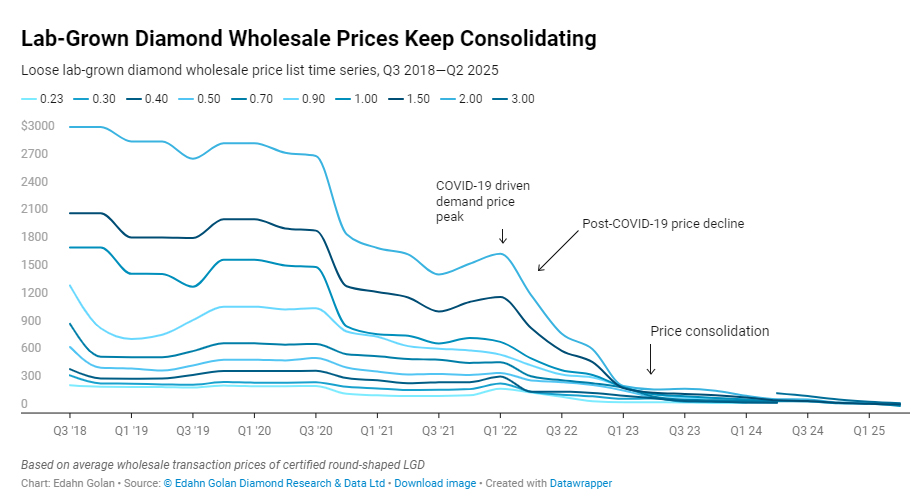
But then, following Covid, some major technological breakthroughs enabled LGD manufacturers to increase production by ~300% almost overnight. This essentially flooded the market, causing the prices of all diamonds to crater in lockstep, even factoring in the “stigma delta” between LGD’s and the real thing.
Shot:
Chaser:
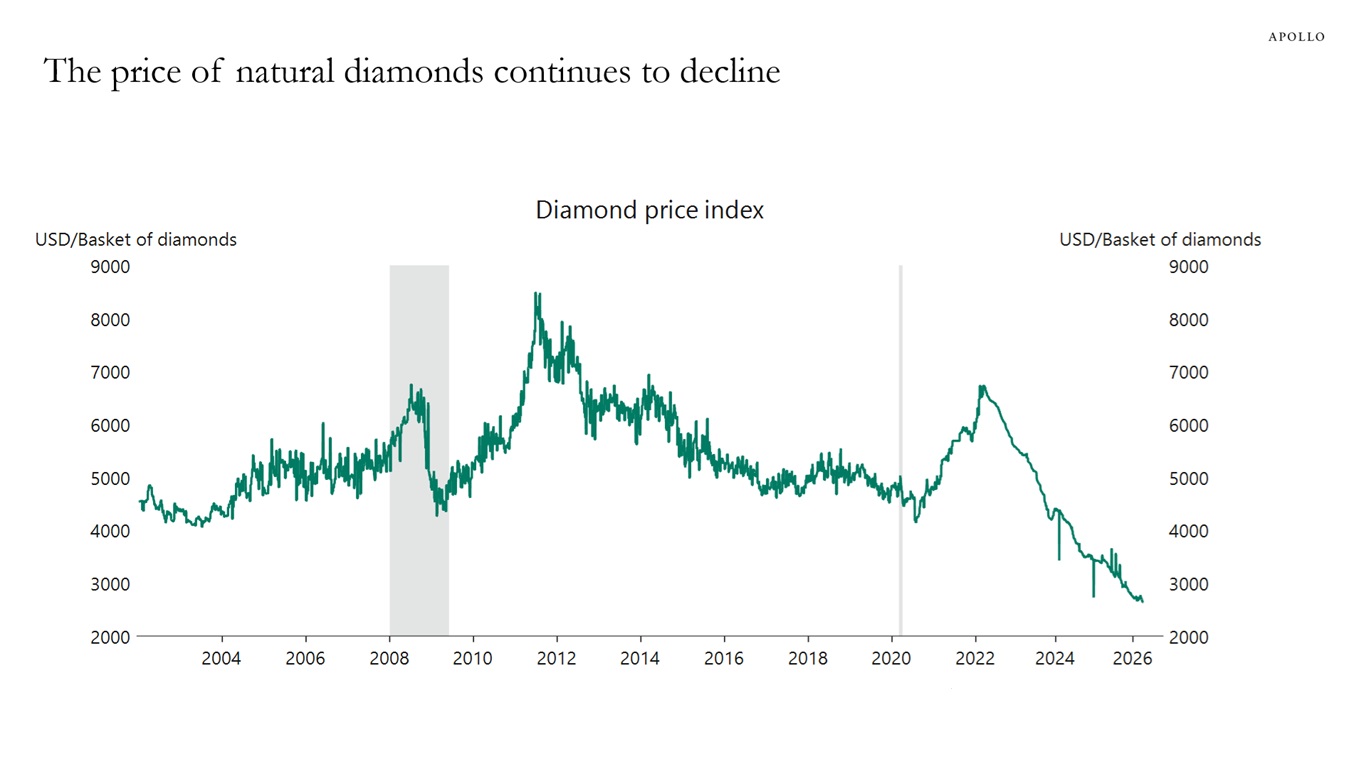
As with the whalers, I suspect the fat lady has sung for our friends at De Beers as well.
Diamonds are, in fact, not forever.
At this point, you might be wondering what in the hell whales and diamonds have to do with you, me, and our fate as internet entrepreneurs.
Well, everything, as it turns out.
Our Own LightBulb Moment
I think in a decade or so, we won’t view AI as a fascinating breakthrough, Nor will we endlessly ponder what it all means for XYZ thing/industry/whatever.
AI, and all of its implications, will become the proverbial “box of lightbulbs” at the back of the shed. We won’t even think give it a second thought. Even though its origins and initial adoption had massive ramifications for millions of people at the time.
Which is great for all those future people. Unfortunately for you & I though, we’re currently in the “massive ramifications” group.
We’re the ones who get to watch the entire digital economy become crowded out with a lab grown alternative that, albeit not quite as good the real thing, is essentially free & unlimited in volume – so it drags down the perceived value of everything, regardless.
Just like natural diamonds.
Which begs the question… what’s actually worth building, doing and selling anymore?
I’ve been thinking about this a lot. Here’s where I’ve landed…
You Now Need A Scarcity Mindset
Whether it’s whale oil, natural diamonds, content creation, sales copy, digital courses, graphic design, video editing, website creation, SaaS tools, social media management – or any of a thousand other things that AI is currently making easier than ever, instantly accessible and nearly free…
….the solution isn’t to try and outsmart the market, or make the argument that your “diamonds” are better, the real thing, and still worth the ever-shrinking premium you’re asking.
Instead, you need to ask yourself:
What’s scarce, valuable and something that AI can’t mass-produce?
For online entrepreneurs, here’s my take on what’s scarce, what’s not, a bit of nuance, and where I see the main opportunities currently. What follows are some examples that you can extrapolate from – this is not an exhaustive list.
Examples of what is no longer scarce:
- Blogging for SEO. Even if Google didn’t pull the rug, GenAI is flooding the zone. It’s simply too easy to load up a website with 500 keywords or whatever and let AI do the rest.
- On-demand digital courses. Unless this is augmented with live sessions (cohort, 1:1 coaching, DWY assignments, etc), it’s tough to compete with a chatbot that seems to know everything and can personalize it all to your exact situation.
- Low-specialty DFY services. Things like data entry, transcription, basic content creation, simple graphic design, editing, basic websites, etc.
Examples of what is becoming less scarce – nuance required:
- SaaS. Especially stuff like off the shelf productivity tools, AI wrappers or otherwise things designed for broke startups (who can now all vibe-code their own workflow stack in a weekend).
- Medium-specialty DFY services. Things like reselling SEO, running ads for local businesses, funnel builds, social media management, etc. Especially if you’re largely just fulfilling with an agentic workflow vs dedicated talent.
- Casual audiences. Think: ad-supported faceless channels, roundup-style newsletters, parody accounts, general interest influencers, etc. If there’s no distinctive personality, experience or judgment – AI will eventually displace it.
Examples of what is truly scarce, valuable and can’t be “replaced” by AI:
- Enthusiast, resonant audiences that you own. Building a highly engaged audience (email, SMS, Skool groups, etc) in valuable niches or B2B categories is still worth a fortune. I’d include a brand here as well, since you can rapidly “port” your following to any platform if you’re well-known.
- Proprietary data and primary research. AI is the ultimate regurgitator, but it only “knows” what it can find. If you hand-collect your own data, conduct your own interviews, run your own surveys, prospect your own leads… etc. then AI becomes a distribution & assembly partner instead of your own replacement.
- Deep workflow & Build-to-Suit SaaS. Instead of building software that’s “good enough” for thousands of customers and charging a nominal monthly fee, you build bespoke, one-off customizations for a few dozen customers that directly interacts with their business, seamlessly. Then you manage, maintain or even run it for them as an ongoing service. This is obviously a lot more expensive, but you’ll have way less churn and your customers get an end-to-end solution and far better outcomes.
- Niche communities. events & marketplaces. We are social animals. This will never be replaced. And if you build a community that eventually functions as a marketplace in high-value industries (like Informa or IndustryDive)… money will find you, very quickly.
- Vetted networks & direct intros. Private industry peer groups are becoming more and more common, and it’s also a sort of “power broker” model as well. For example, if you run a community for CTOs in healthcare, you can arrange deals for your members where XYZ company will pay ~$3,000 for an introduction and guaranteed 30-minute call with any of your CTOs who are in-market for their product (eg. HIPPA compliant CRM).
You could pay each participant $1,500 for their time, and keep the other half as your margin. In exchange, the client (XYZ corp) gets to shortcut all the usual call funnel BS, no-shows, etc and spend about the same per qualified call as they would with Google Ads, anyway. Arrange just 10 intro calls a month across your members and that’s $200K/yr.
Basically the common thread is that your own humanity (and human connection, judgment, conversations, novel experiences, genuinely new discoveries, etc) is now what’s scarce, valuable and irreplaceable.
AI can’t be the source of your value. It can only be a multiplier.
There are many other examples like this – I’ve only scratched the surface – but I think you get the idea.
Now let’s talk about what this all means for me, you, and everyone else who’s in the same boat…
A Tale of Two Startups
Maybe the best way to show you just how much AI has flipped the value equation is to talk about what it’s like to build a SaaS business in a post-AI world vs. what it involved just a few years ago.
As some of you might remember, I launched a software startup called Zag in 2018. It was a collection of insights & analytics tools for content marketers, similar to BuzzSumo. Here’s a snap from the old homepage:

It had some pretty cool features. One of tools was even an early form of LLM that used natural language processing to extend your keyword ideation beyond the obvious.
Zag took about 6 months to scope & wireframe – including researching how to actually make the apps work (API options, scoping custom stuff, etc), and then about a full year of actual development to get to a working MVP. Then there was the marketing assets, UI reskinning, etc.
So call it 2 years, with a small team of 4 people including myself. I invested about $200K to bring it all to life. The vast majority of that was software development at $50 – $100/hr.
Long story short, I guess I should’ve Zigged. The platform managed to recoup about ~$100K in revenue over its lifecycle (I finally retired it in 2022), and I was able to sell the domain itself for a decent 5-figure amount last year, but it certainly wasn’t a success, and the real cost was the opportunity loss over a 3+ year span.
I definitely learned a lot, and that’s something I suppose. One of the things I learned is that it’s a lot harder to sell insights, competitor intelligence, and in general, things that tell you what to do… vs. just doing those things for customers directly.
I would never build a “vitamin” product again – something that’s nice to have. You’re far better off selling “painkillers”.
Now, let’s fast forward to my current SaaS project, which just crossed MVP status last week…
It’s called Echelon, and if you’d told me that I could’ve built this for just $200K back in 2018, I would’ve crapped my pants.
Except, it didn’t cost me anything close to $200K.
But let me quickly walk you through what it does. Then, I’ll tell how long it took to build, and how much it cost. And then I’ll talk about what that means for all of us.
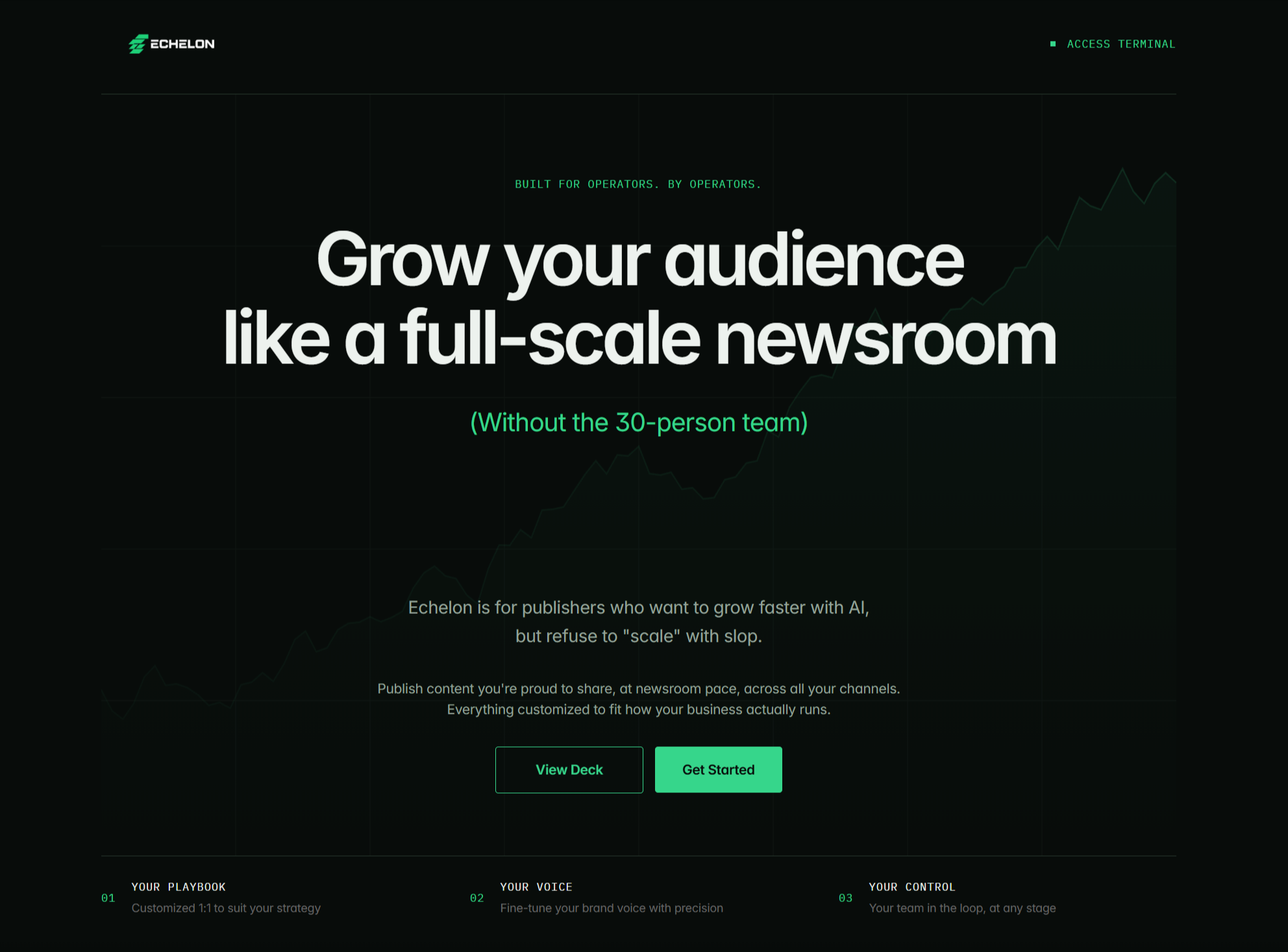
Unlike Zag, Echelon doesn’t give you ideas about how to grow your owned audience.
It actually fulfills your entire content process, and grows your audience for you.
Here’s the high notes:
- Create unlimited research agents to crawl the web as deep or wide as you want, and generate targeted content briefs, at any scale
- Example: Follow 100 specific experts in your niche across all their channels and track their every post, video, etc. in real time, pulling in anything you care about into a rolling report, on whatever schedule you set.
- Hand those briefs to your team, or use them directly in-platform as a reference source to generate your own content in seconds
- Create longform content that actually sounds like you by pulling from your specific voice/style references & info sources.
- Repurpose your existing content into dozens of social assets in seconds – watch this month’s blog post turn into 4 weeks worth of posts across X, LinkedIn, Instagram, etc. Optionally generate images and 1st comment CTAs alongside.
- Easily spot-edit manually or with quick prompts to get it right. Use the Queue to shortlist anything that looks good on first pass for final revisions or hand that off to your team, in platform.
- Once stuff is ready to ship, push it straight to your social channels, email platform or website, or schedule it, directly from Echelon.
- After stuff is posted, measure its performance directly in the platform, both with some useful preset screens, as well as an unlimited number of custom insight queries you create.
- Best of all: Remain in complete control of how everything actually works. Connect whatever AI services you want, and specify which model to use for any given task. Use our default prompts or customize your own. There’s no black box, and you can fine-tune everything down to the pixel.
In short, this lets you become a newsroom in your market for a few hundred bucks in AI tokens (vs a 7-figure payroll).
Everything I just described above is actually built and working. I’ll have a fancier site and a proper demo video up in a few weeks, but you get the gist of it.
And suffice it to say, I think it’s a fair bit more compelling than Zag. Which is why it might seem confusing to hear me say the following:
I don’t want customers.
At least, not in the conventional SaaS model. Here’s why:
- Echelon wasn’t even an idea in my head until mid August this year.
- I spent a few weeks wireframing it, and figured I might as well try this thing called “Claude Code” that my friends couldn’t shut up about, and see if it could actually push the boundaries of what’s possible for my own marketing ops
- Since I was already planning to launch a financial newsletter as a side project in Q4, I instead pondered: “Why not create a factory for growing a newsletter first, then run it through its paces, and kill two birds with one stone?”
- I “wrote” my first line of code with Claude on August 30th
- Echelon is now a legit MVP, officially running its first campaigns as of Nov 11th
- Across my entire tech stack, including Claude Code, I have spent just shy of $600 CAD, in total to date. This includes my actual token spend with testing various LLMs, scrapers, infra layers, etc.
- And most importantly – to go from wireframe to functioning MVP for an enterprise publishing operating system – with me building the entire thing solo, as a non-developer – took just over 2 months.
Echelon is already 100X the platform Zag ever was. And it’s so useful for my own business that I literally don’t even care if it ever has a single outside customer. It is basically my exact 1:1 strategy, expressed as my own personal SaaS.
Think about that: $200K and 2 years, vs ~$600 and 2 months.
Now, we need to talk about what this means from a “scarcity mindset”…
While I don’t think conventional SaaS as a business model is cooked – I do think it’s going to be significantly harder to find a defensible moat. Especially if you don’t have something like proprietary data, deep infrastructure (eg. proxy services) or on-demand customization layered in.
Because if an idiot like me can build Echelon… what does this look like a year from now with Fable 9 / Astra 10, or whatever?
It’s only going to get faster and easier for companies of any size to build their own software & automated workflows. Even casual individuals will start doing this – and that’s assuming that the native chat apps (Claude, ChatGPT etc) don’t just eat it all natively.
For all of these reasons, I think the smart play, in this example, is to do the following:
- Actually use Echelon myself to build and grow scarce assets – namely, engaged newsletters in high-value niches.
- Potentially offer it to customers as a service rather than a product. Meaning, we actually build them their own 1:1 version of Echelon, on their own repo instance, customized to their own strategy, workflows, integrations… etc etc. with various levels of after-support or outright just running it for them.
That way, in line with my earlier thoughts, you protect the human element (scoping something that’s actually worth building), and it’s truly scarce – since someone would have to customize, deploy, test, stabilize and maintain it anyway.
But enough about software. Let’s wrap by talking about something that almost everyone reading this can actually put into action…
The One Thing
A few weeks ago there was a trend on X where people were describing the entirety of their business model, distilled down to a single sentence.
For my own business, I gave it some thought, and came up with this:
I give people ideas that make them feel smart and special, sometimes for free, sometimes as a product, and sometimes as a service. I do this by asking them to sign up for an email list, then I send them interesting emails and offers.
This might sound like a pedantic exercise, but I think it’s also a great way to give yourself a reset, and potentially re-prioritize what you’re doing each day.
I was surprised at how many of these “statements” people were making were similarly still centered around grabbing an email, and building a relationship with the reader. This was basically the “OG” business model going back to the early internet of the 90s.
“The money is in the list”. How many times have we heard that?
But it’s as true today as it ever was then. Possibly even moreso.
And given everything we just discussed, it’s also the most realistic way for most internet entrepreneurs to build something truly scarce and valuable in a post-AI reality.
Who would’ve guessed that the most future-proof business model heading into 2027, as AI eats the world, is the one thing that’s always worked, from day one?
So I don’t know about diamonds, but maybe it’s safe to say that Emails are Forever...
(At least in internet years).
~ Chris
P.S. If you’d like to watch me actually build that financial newsletter, from scratch, and see everything as it actually happens (warts and all) for the next 6 months, you might be interested in this >